Augmenting Human Performance with an XR Agent Learning from Online Behavior and BCI Evidence
Ziheng Li*, Xichen He*, Haoyan Chen*, Charlie Zou*, Sheng Bai, Benjamin Yang, Mengyuan Wu, Jake Ledner, Yi-Jie Cheng, Akito Yamauchi, Dishita G. Turakhia, Steven Feiner, and Paul Sajda
In ACM Symposium on User Interface Software and Technology (UIST), 2026
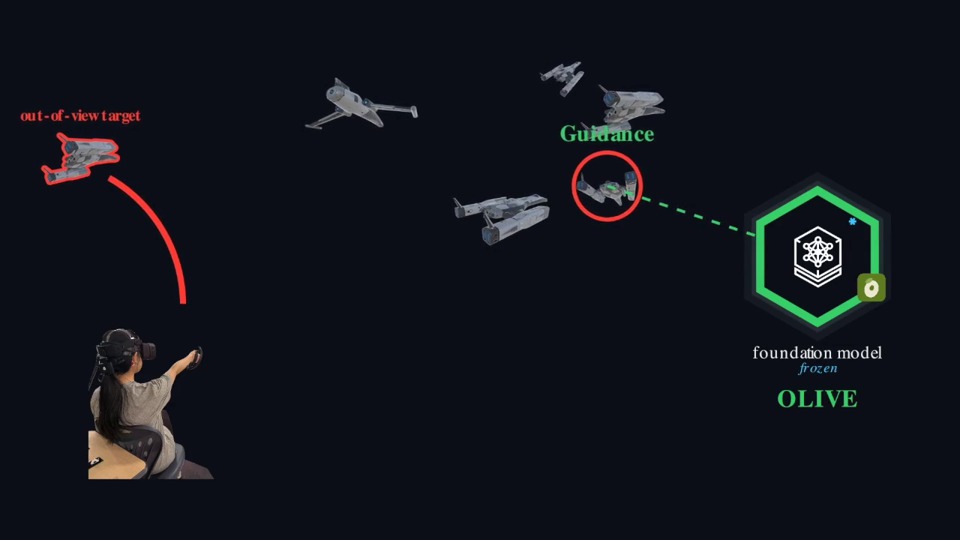
We present OLIVE, a framework for adapting a foundation model to provide real-time assistance in temporally demanding, high-stakes and dynamic tasks. OLIVE learns from both explicit behavioral signals (user actions) and implicit physiological signals (fixation-locked EEG) to provide timely guidance to supplement the user’s perceptual and action bandwidth. By fusing these complementary channels, OLIVE continuously adapts a frozen vision-language model’s belief about which items are currently task-relevant, jointly estimating per-source reliability without manual labels or offline retraining. Through three user studies, where we deploy an assistive agent driven by OLIVE in XR, we show that OLIVE outperforms prior test-time adaptation frameworks in both convergence time and rate. Compared to learning from explicit behaviors alone, the agent combining implicit and explicit learning signals improves user performance, achieving 45% more target coverage. When targets shift silently mid-block, the combined agent re-adapts 2.1x faster than the behavioral-only baseline. These results show OLIVE can be built toward empowering adaptive co-pilot systems that extend human performance under demanding operational conditions.
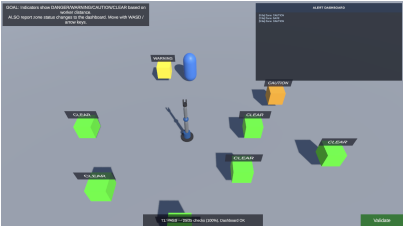 Cascade: Spatial Routing Abstractions for Human Developers and AI Coding AgentsIn ACM CHI Conference on Human Factors in Computing Systems (CHI)Resubmitted to CHI 2027; under review. , 2027